Spoiler Warning


Always assume Spoilers and possible profanity in context. These are often adult themed movies.


Showing posts with label crime movies. Show all posts

Friday, July 13, 2012

Croupier

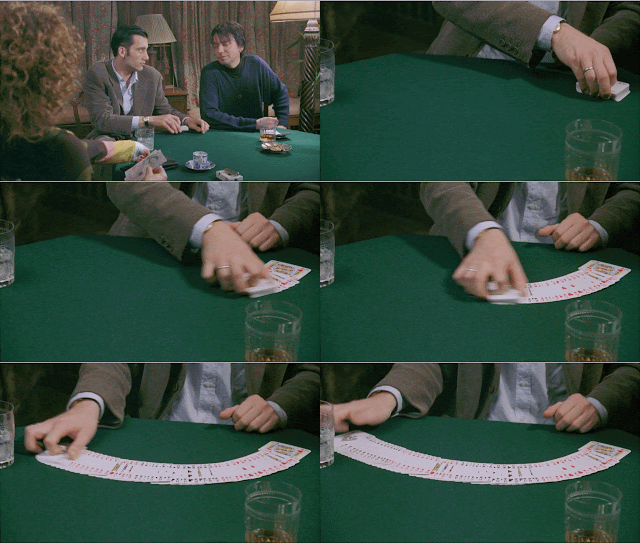
The folks over at Awesome B Movies were kind enough to invite me to do a guest post over at their site. Take a look over there, as I look at Mike Hodges' 1998 Gambling/Crime film, "Croupier" starring Clive Owen before he was everywhere. Click on the picture to go there:


I should also point out that Criminal Movies is now on Tumblr as well. If you like pictures and animated .gifs from the films I look at here, by all means keep an eye out over there. Click on the picture below to check that out:


If you're on Facebook, stop in and like my page there, for more on my Criminal Movies selections (trailers, theme music, interviews) Just follow the link on the right of the page to go there. If you're partial to GooglePlus, there's a page ad link there too.


Lastly, If you follow Criminal Movies via feed, you'll want to update the feed address. I had to change it recently as some former associates would not disable auto publishing to a site I no longer have anything to do with. It's all mine again now though. You can use the feeds button on the right, or here's the new address: http://feeds.feedburner.com/Criminal-Movies


Tuesday, May 22, 2012

Rampart

What Happens

Woody Harrelson is Dave Brown, an L.A. cop. on the force in the 1990's. The force is still dealing full time with the fallout from the Rampart  corruption scandal.  Many officers including the former chief are gone and the Department is dealing with lawsuits justified and unjustified on a daily basis. You wouldn't know that, however, by watching Dave Brown. He conducts himself as if nothing ever happened, conducting off the book shake downs and random harassment at will. His biggest concern initially is that his rookie partner ordered french fries but isn't going to eat them. "I don't like fries." she tells him. "Well, you shouldn't have ordered them, then." He assures her that not eating her fries will ensure she stays on probation. When she obliges and starts eating them, he investigates further "Did anyone ever discipline you?" After hearing that she's never met her father, he relents and throws her fries away.  He illustrates his own method of racial profiling and "lead generation." for his partner, who questions his methods. He reminds her "Everything you learned in the Academy... it's bullshit." At the station he asks for a warrant for the questionable lead on a crack house, he obtained. When questioned about the lack of background on the address, he cites case law. His partner asks him if he knows all the cases he mentions. He tells here, "If I don't, I just make it up."

Harrelson's family life is an interesting one. He has married two sisters, Barbara (Cynthia Nixon) and Helen (Brie Larson) "consecutively." and had a daughter with each one. Somehow he's managed to keep them living next door to each other, a situation which would be convenient if it worked out like he imagined. He has no compunctions about hitting on one sister for sex, and being turned down, he propositions the other. She also turns him down. Dave Brown's act has gotten old for them. His daughters have a little more tolerance, the younger more than the older. We learn pretty quickly that Dave has reached a point where he's powerless concerning his family. He asks his older daughter about a collage she's put on the wall which contains a woman's heel coming down on a man's face, with the word "Cunt" prominently featured. "What's it all about?" he asks, clearly wishing it taken down. "Figure it out." she tells him. The collage stays up and being shut down on two counts, Dave heads to the bar to find somebody else.

He finds a girl who's "into cops" She coaxes the "handle" his partners use out of him to take a shortcut in getting to know him. She's initially horrified when he tells her his handle is "Date Rape." He quickly assures her that this doesn't refer to his activities directly, but that he "may or may not have" killed a serial date rapist at some point in the past. He gets her in bed, which sadly ends with her shrugging and saying "oh, well."

Dave is patrolling in his squad car, when another car runs right into him. He gets out of his car to approach the other driver, but gets hit with the door before the driver starts running. Dave gives chase, catches the man, and then beats him senseless with his billy club. He doesn't realize that he's being filmed and his actions are almost instantly on TV everywhere. He's asked to explain himself to the Assistant D.A. Joan Confrey (Sigourney Weaver) who starts their conversation, asking if he's thought of retirement. He answers by illustrating a public relations nightmare fore her. "So you have thought of it." she replies. Dave's position is that he was responding to "assault with a deadly weapon." And, he sticks to that.

At the bar, looking for companionship he meets defense attorney, Linda Fentress (Robin Wright) while the TV is showing the beating incident. He has the feeling that she was looking for him. She hates what she does, she tells him, putting criminals back on the streets, but she respects what he did, killing that rapist. The two start a volatile back and forth, based on cheap thrills, enmity, and perhaps career goals.

He soon meets with his mentor figure, shady retired cop, Hartshorn (Ned Beatty.) Hartshorn is more crooked than Dave, although he's much better connected. "Stick to your assault with a deadly weapon story." he advises, and informs him that he's become a target. Hartshorn has a code and he won't name names, however. He does tell Dave he'll try to take some of the heat off of him, and gives him a tip on a backroom card game that should have a lot of money present. Someone else has heard about it too, and as Dave is casing the game, he watches it get robbed. He chases down the robbers killing one of them, and letting another one go with some of the money. He stashes the cash, plants a gun and then calls it in.

Of course this brings him more attention. He finds IA tailing him in the form of Kyle Timkins (Ice Cube) who quite eagerly tells Dave he's going to take him down. Very soon it's clear that Timkins isn't all talk. He has witnesses who saw him outside the card game, the gun the dead man had was used before in a similar situation. At the same time, Barbara tells him they're selling the houses and getting away from him. Dave gets his lawyers on the case, telling him the most important thing is that he remains a cop, although they can't understand this. Hartshorn becomes less helpful, so much so that Dave assumes he's now working against him. "You know the policy. I don't name names." Hartshorn reminds him. Resolving to wash his hands of Dave, he tells him "Everyone changes, but not you."

His oldest daughter, Helen tracks him down at the station to talk. She tells him "You're a dinosaur, Date Rape. You're a classic racist, a bigot, a sexist, a womanizer, a chauvinist, a misanthrope, homophobic clearly, or maybe you don't like yourself." He responds with a joke about her sexuality, and of course she takes off."

The pressure ratchets up, Assistant D.A. Confrey, who had asked him off the record about the "Date Rape" murder reminds him that the murdered mans wife went crazy, and his daughters ended up abused in foster homes. Confronted in his hotel room by both of his daughters who have come to drop off some of his clothes. He tells them he knows why they came. They're wondering about the things they hear about him. He provides little comfort, telling them "Everything you've heard and more, it's all true."


What About It?

Rampart isn't a conventional story, as much as it is a peek into the life of a man who has failed everyone around him in every way imaginable. he's a bad cop, a bad father, husband, friend, lover, and everything else you can name. He lives for the power that comes along with the badge, and with every abuse of that power, he feels he has more. His character, would be easier to deal with if he were simply a mindless thug, but he isn't. He's more resourceful than he lets on. Although we don't know how much of the case law he quotes is real and how much made up, he does have a sense of what will help him in most situations.

His home life is an interesting contrast to his cop life. His presence at home seems to matter very little to anyone, except that they've grown tired of being associated with the mess he's making all around him. As tough as he is with his "scumbags" on the street, women seem to render him powerless (in more ways than one) Dave Brown seems to have lost touch with the idea of consequences. The fact that he remains on the force after the Rampart scandal removed so much corruption makes him feel invincible. When speaking with the Assistant D.A., he refers to himself as "the only one who gets it." a notion which makes her laugh. Even while he's displayed endlessly on TV as an example of police brutality, he thinks nothing of staging a shooting    and planting a gun to steal some money. To Dave Brown, that's what the job is, his every action is acceptable because he's not a "scumbag" but a cop. Dave doesn't seem to know his own agenda, he's instinctual just doing what he does, when he gets to it.

Dave Brown is a departure from the classic dirty cop in that he isn't driven by being a junkie, or money that comes in from being "on the take." Dirty money is certainly ok with him, but he's not chasing it, just taking it when it's in his path. He enjoys being a cop, but his idea of what a cop is includes every corrupt thing he can imagine, retroactively. He clearly feels much pride over the "Date Rape" incident. He can't help but smirk when he gives his "can neither confirm nor deny" line. His spin on the incident varies. On one occasion, he says he did it to help him meet girls, and on another he says it was because he has daughters. In his mind those things could both be true as well as any number of other explanations. He's clearly not, however defending the honor of women in any way. Much like the case law he quotes, he likely killed the guy, and then came up with the justification afterwards. The important thing about the incident is that we're told it was premeditated. Unlike the shooting of the robbers at the card game (who possibly did have guns) the Date Rape incident was a calculated murder. But with Brown, premeditated murder is something else that's Ok because he did it, and he's a cop. You can't predict what Dave Brown will do. He's the cop who robs you after you pay him off, simply because he can.

I'm sure that many are unhappy with the film's conclusion, as everything is not wrapped up. We leave Dave in the middle with everything still closing in around him. But, for what the movie is, I think it makes sense. Things are catching up with Dave every day, more and more. He doesn't change, although everything around him does, leaving him further and further behind. We glimpse Dave considering ending it all. We see that he's unable to eat without throwing up. Dave Brown is someone who's miserable in his own skin. And given his behavior that revulsion is contagious. He knows what he is, and won't ever apologize for it, not even to make his daughters sleep a little easier. Does he hate himself? Probably, but he loves himself too, too much to make the slightest attempt at change. Harrelson's performance here is brilliant. In a way, he's more frightening than he was in Natural Born Killers, because at least Mickey was in love and wanted something. Dave Brown isn't capable of either love or wanting anything. We're given a character that's beyond redemption, but not one without empathy. We hope he'll change and get out of his own way, although at the same time, we know he never will. That's likely a story his wives have been through many times, and he himself must live with constantly, although never really entertaining it.

The supporting cast is terrific as well. Brie Larson is a great Helen, conflicted and resentful, but astute. She's determined to tell her father what he is, although a bit disappointed to find that he's already well aware.  Anne Heche and Cynthia Nixon both perform well, for the small amount of screen time they have. We get their disgust and boredom both at the same time. Robin Wright's performance is great and I think a good mirror for Dave. In her own way, she's as volatile as he is, although her position is safer as it keeps her within the law. Sigourney Weaver is a good choice as the assistant D.A. She isn't impressed with Dave, but nonetheless can't help but be puzzled. She doesn't understand how a man like this can exist. He's like a Rubik's cube, although one that is damaging the department. Ben Foster puts in a good show as a homeless alcoholic, who Dave thinks to use, but later regrets. I enjoyed watching Ned Beatty also as the only character in the movie sleazier than Dave Brown. Beatty has a gift for these parts.

Moverman's direction is quite clear about our focus. Dave Brown is the movie, and we only see it as it relates to him. With James Ellroy and Moverman as writers, it's not surprising that the details presented are smart and serve the story. We're shown people as they act, everything already in motion.  All of their troubles are not spelled out in so many words, but we can find their histories in how they talk and deal with each other. Dave Brown is a terror on the streets, but at home he's a guest at the dinner table. His oldest daughter get angry when Dave pats her hair. "Don't touch me," she says "Say something." We see the look on his youngest daughter's face, finally seeing what her father is, and it says much more than when she turns to her sister and tells her they should go. In Dave himself we can see the whole story, and wherever it ends in the film, anyone can figure out that Dave's story doesn't end well. When Dave and Linda Fentress engage, we don't know where it will go this time, but that both will regret it and likely do it again. We also know everything is not on the table, but we fill it in with what happens next.


Wednesday, October 19, 2011

Top Ten Crime Bosses

People love gangster movies, and there's no one as important in gangster films as the big boss. Even when you don't see him, his threat is always there. For most gangsters in film there's always something the boss could discover that seals your fate, or it could just be your own bad luck. Most often, gangster films concern themselves with the daily operations of people in criminal organizations. But there is also the "rise to power" film, detailing the journey from the bottom to the top. Few gangsters ever make it all the way, and if they do, the odds of retiring or dying of old age are not so great. Nonetheless, many dream of being the top guy, because it means all the money, and power, the brass ring of the criminal life.

Of course when you're the head of a large group made up of criminals, it's hard to trust anyone. There's bound to be someone as ruthless as you, wanting your spot, or the cops you don't own, plotting to take you down. All the same, it's somebody's American Dream, have all the luxury and power you want, and all you have to do is figure out how to keep it. As unbelievable as it may seem, many of such stories are based on actual events (although some more loosely than others.)

I've tried not to dominate my list with the same actors, (although having two from Pacino was unavoidable.) and only include films where the boss has a prominent role. Please feel free to add your own suggestions. I'd love to hear what your agreements/disagreements. There are certainly many other worthy roles. I've also included links to full reviews on those films that I've covered in a past entry.

10. Brick Top (Alan Ford, Snatch)

Brick Top is a long way from a Corleone type. He controls the local boxing circuit and associated gambling with ruthlessness and hungry pigs. Turkish (Jason Statham) and Tommy (Stephen Graham) need to get their boxer onto Brick Top's books. After finally getting him to agree, they run into a group of gypsies and find one of their number, Mickey (Brad Pitt) can easily lay out their prized boxer with one punch. With their boxer incapacitated and very impressed with Mickey, Turkish thinks to have Mickey fight for them. Brick Top isn't happy with the switch and demands Mickey throw the fight. Mickey, however isn't good at following directions and knock the other fighter out immediately. Meanwhile Bricktop also has to deal with some would be thieves who happened to hit up one of his bookies, who unexpectedly came into possession of a corpse and are having trouble getting rid of it. He enlightens them as to his preferred methods:  "the best thing to do is feed them to pigs. You got to starve the pigs for a few days, then the sight of a chopped-up body will look like curry to a pisshead. You gotta shave the heads of your victims, and pull the teeth out for the sake of the piggies' digestion. You could do this afterwards, of course, but you don't want to go sievin' through pig shit, now do you? They will go through bone like butter. You need at least sixteen pigs to finish the job in one sitting, so be wary of any man who keeps a pig farm. They will go through a body that weighs 200 pounds in about eight minutes. That means that a single pig can consume two pounds of uncooked flesh every minute. Hence the expression, "as greedy as a pig." And of course, Bricktop has a pig farm, and intends his advice to affect them very personally until they tell him about the diamond they're after. Brick Top gives Turkish another chance, burning Mickey's mother to death and destroying slot machines which are Turkish's other income as a a warning. Mickey doesn't follow orders again, getting Turkish and Tommy into deeper trouble. Brick Top sets out to exact his revenge, not realizing that Mickey expected it and set up his fellow gypsies to take him and his men out first. Alan Ford gives us a nasty and ruthless Brick Top, who exudes enough hatred with a look to frighten most normal people. His downfall is not realizing that Mickey doesn't follow those rules.
   

9. Al Capone (Robert DeNiro, The Untouchables)

While certainly not DeNiro's best performance, he does just fine making the figure of Al Capone a large one. In the Untouchables we get him as a seemingly unbeatable opponent. Elliot Ness (Kevin Costner) is trying everything he can, but can't get near him, as much of the police force that Ness relies on is under Capone's control. It isn't until he listens to a little advice from agent Jim Malone (Sean Connery) who advises Ness "He pulls a knife, you pull a gun."  Ness takes the advice, and starts hitting harder. This doesn't stop Capone, however, who continues his business as usual, threatens the lives of Ness' family (and Ness himself of course.) He declares, "I want you to get this fuck where he breathes! I want you to find this nancy-boy Eliot Ness, I want him DEAD! I want his family DEAD! I want his house burned to the GROUND! I wanna go there in the middle of the night and I wanna PISS ON HIS ASHES!" Capone even has some of Ness' men killed (including Malone.) Finally deciding to go after him for tax evasion, and getting him into court, they find an unbothered Capone, who's all smiles. His main hitman, Frank Nitti has been allowed by the corrupt mayor to bring his gun into court. Ness can't abide this, knowing Nitti killed Malone, and calls him on it, leading to a showdown, which ends with Nitti dead, and the revelation that the jurors were bribed and the judge is intimidated too. Ness manages to set things right and finally gets Capone into prison, but it wasn't easy.          


8. Harry (Ralph Fiennes, In Bruges)

Full Review

Harry carries himself more as a business man than a crime boss, conducting himself in a proper family man, while giving orders over the telephone. Harry has a very particular way he likes things done. In, "In Bruges"he has decided to kill one of his own hit men, Ray (Colin Farrell) and sends him to Bruges with friend and longtime associate, Ken (Brendan Gleeson) reasoning that Bruges is a town that's "like a fairytale" in order to give Ray a nice time before he's killed. Ray, however, despises Bruges and Ken isn't able to bring himself to kill him, and actually stops Ray from killing himself over his accidental shooting of an innocent little boy. (which is why Harry wants to kill him) When Ken informs Harry that he won't do it, Harry heads to Bruges himself and tells Harry that Ray should've killed himself the moment that he killed the kid, and that's what he himself would've done. He wounds Ken, rather than killing him, although Ken sacrifices himself anyway, to alert Ray. During an extended chase, where Harry takes great pains not to injure innocent people, he accidentally shoots a dwarf actor dressed up as a schoolboy, and is obliged to live up to what he had said earlier, immediately killing himself, while Ray, perhaps unwisely, tries to alert him to his error. Fiennes is terrific as a frightening but amusing and relatable boss, who truly believes in the code he insists on.

7. John Rooney (Paul Newman, The Road to Perdition)

Full Review

John Rooney (Paul Newman) is the head of the Irish mafia in an Illinois town, controlling nearly everything that happens there. His top hit man is Michael Sullivan Sr., an orphan he took in when he was young and has great affection for.
Rooney's actual son, Connor, however, is a psychotic loose cannon, who kills a man needlessly. Michael Sr. and Connor then discover that young Michael Jr. had hidden in the car and seen the whole event. Without his father's approval or knowledge, Connor attempts to have Michael Sr. killed, while he himself kills Michael's family with the exception of Michael Jr., who wasn't home. Sullivan goes on the run with his son, and approaches Al Capone's people, to try and get approval to kill Connor. They however, don't oblige and Sullivan starts robbing banks of strictly money held for Capone, hoping to pressure them to turn over Connor. He obtains information that Connor had been stealing from his father and shares it with John, but John already knew that and despite his feelings and affection for Michael, he can't turn on his own son. Sullivan meets John Rooney later that night, effortlessly picking off all of his men, before nearing Rooney, who he finishes off up close and face to face. Rooney understands, and tells him "I'm glad it was you." With the elder Rooney dead, Capone doesn't care about Connor and gives him up, although Michael still has a hit man pursuing him and a son to keep safe. Paul Newman gives us a memorable figure who we know has to go, but we still sympathize when Michael feels bad about it.

6. Frank Lucas (Denzel Washington, American Gangster)

Although Frank Lucas is the extremely successful head of a drug dealing organization, he differs from many crime bosses, in that you'd never know it. While certainly not above murder, or ruthlessness, he's more concerned with making money and keeping his ship in good shape. He patiently learns everything he can from his boss, Bumpy Johnson, until he dies and hands over the operation. Not happy with the status quo (inferior product, lots of hassle, not enough money) He arranges to go straight to the source, and rather than deal with the mafia, he brings his drugs in from Viet Nam. This gives him a pure product at a price the middlemen can't compete with. He takes pains to treat his people right, and instructs them not to be flashy. He's content to stay low profile if it brings the money in. However super honest Officer Richie Roberts (Russell Crowe) notices him at the one moment he forgets about keeping a low profile. With extreme perseverance, Roberts sets out to bring Lucas down. Once Roberts has him, Lucas, ever the businessman, agrees to be helpful for a lenient sentence, turning on his associates as well as all the dirty cops he dealt with. Denzel Washington makes Frank Lucas a crime boss who tries to care about his family and his neighborhood. Drugs to him are just product, and by his reasoning, if they weren't purchased from him, they'd be bought somewhere else. Denzel Washington handles the role quite capably, making Frank admirable for his ingenuity and intelligence.


5. Frank Costello (Jack Nicholson, The Departed)

Frank Costello is a powerful crime boss in Boston. He's admired by a young boy, Colin (Matt Damon) who Costello recognizes as a great possible resource and grooms him as he grows up to get on the Boston Police force to serve as his mole. At the same time, Billy Costigan (Leo Dicaprio) is going the opposite way, he'd like to be a cop, but his family background, makes him perfect for the police to use against Costello. Costello's group and the police both become aware of moles, and much effort is spent by both sides to find them. Colin however, finds unexpected news in his search, that Costello himself, is a mole for the FBI, leading Colin to question his motives and actions, and ultimately, it isn't Costigan that brings Costello down, but Colin, angry at the betrayal, and justified because Costello attempted to kill him when confronted on it.  Of course Colin and Billy have business to finish up, but it's Costigan that put it all in motion. Nicholson gives us the ultimate manipulator, a man who has a use in mind for everyone he meets and ultimately proves that his only loyalty is to himself. As likely to have you killed as tell you a joke, he's a truly distinctive character who prides himself on details, yet can't possibly keep track of them all. Nicholson gives us crude charm and psychosis in one package.

Keyser Soze (Kevin  Spacy, The Usual Suspects)


Soze is a different kind of crime boss in that no one knows if he exists or not. He's a malevolent figure who has put so much effort into his own reputation that his name is enough to frighten people. Criminals do jobs for Soze without even knowing they're working for him. Even when he's caught, they don't know they have him. Customs agent Kuljan (Chazz Palmienteri) knows something his off in his investigation of a horrible dock fire, and confronts the only survivor, Verbal Kint (Kevin Spacey) who has already cut a deal about his own involvement. Kint walks with a limp and appears the weak link in the group of criminals involved in the fire.  He tells Kuljan an interesting story about how a heist was put together, portraying Dean Keaton (Gabriel Byrne) as a possible Soze, knowing that's Kuljan wants to hear. However, as Kint leaves the station, Kuljan realizes that many details of Kint's story were fabricated based on items Kint was looking at in the office. A fax comes over with a drawing of Soze, from a nearly dead eyewitness, and it looks just like Verbal. Kuljan rushes out to the street, where Verbal's limp has suddenly corrected itself and he gets into a waiting car, leaving Kuljan to ponder his words "The best trick the devil ever pulled was making people believe he doesn't exist."  Kevin Spacey is great, playing essentially two parts, the clumsy Kint that we see, and the mastermind, Soze hidden beneath.

3. Frank White (Christopher Walken, King of New York)

Full Review

Frank White gets out of prison with a vision to give his city a makeover. His first move is to eliminate a rival gang because he doesn't like the way they do business (child prostitution among other things.) He wants to give the city a new hospital. He considers running for mayor, and decides to give the city a new hospital. The hospital project is to be started with Frank's drug money. He offers a local triad a chance to get on it, but when they turn him down, he and his gang kill them all and take their hidden drugs. The police are soon gunning for Frank and his men and succeed in getting one of his crew to sell Frank out. Frank finds out and punishes the rat, but the police are all after him and take out most of his crew, but not without heavy losses themselves. Frank catches up with head detective Roy Bishop (Victor Argo) and explains the situation, as well as his plan to put bounties on the heads of all the cops involved.  Bishop asks Frank if he thought he'd get away with all the killing. Frank simply answers "I never killed anyone that didn't deserve it." Bishop pursues Frank into a subway car, causing Frank to drop his Robin Hood image a moment, taking a woman hostage. He shoots and kills Bishop, who gets a shot off himself. Frank realizes he's been shot and dies himself pretty shortly. In one of Christopher Walken's best roles, he makes Frank a complex character, a man truly wanting to help, but not familiar with sensible ways of doing so.


2. Tony Montana (Al Pacino, Scarface)
Full Review

Tony Montana comes to Miami, Florida from Cuba with nothing but aggression and desire. He agrees to deliver some cocaine and collect payment. The job goes wrong, but Tony gains the upper hand, walking away with both the cocaine and money. He quickly gets connected with a local crime figure, Frank Lopez (Robert Loggia) but soon outgrows the association, taking advantage of a trip to Bolivia to start setting up his own deals with Frank's supplier, Sosa. Tony wants more than working for someone else can provide. He leaves Lopez behind to make his own money and starts pursuing his wife Elvira (Michelle Pfeiffer) Frank, threatened by Tony's success, moves to have him killed, but fails. Tony calls Frank on his attempt, killing both Frank and a cop he associates with. His business is wildly successful, but into a hitch when he's busted by an undercover cop. Sosa gives Tony an option to avoid prison, calling in influential friends to protect Tony if he assists in the killing of a Bolivian journalist. When the journalist's family gets involved Tony kills the Bolivian hit man to save them. Sosa declares war on Tony, sending an army of his men after him. He seems indestructible for awhile but they keep coming finally shooting him from behind. Scarface shows us a man who wants everything and won't be stopped until he gets it and explores the limits of how much force is required to keep it. Pacino is brilliant as a practical force of nature, a man unwilling and perhaps unable to recognize any limitation except the final one.


1. Michael Corleone (Al Pacino, The Godfather)

Michael Corleone comes from a powerful crime family, his father Vito, being the Don of one of the "five families." Michael starts out removed from the family business, returning home from a stint in the Marines. He makes a point of telling his girlfriend that he isn't like them. Don Vito refuses the Virgil Sollozo's (Tattaglia family backed) request for support with his heroin operation, as he believes drugs will damage his influence. Don Vito sends one of his men to infiltrate the Tattaglia backed operation, but he's quickly found out and killed, followed by an assassination attempt on Don Vito himself. The eldest Corleone, Sonny (James Caan) handles operations for a while, but Michael soon gets personally involved. While visiting his father at the hospital Michael discovers he's unguarded. He saves his father and gets severely beaten, mouthing off to a corrupt cop. Sonny retaliates having the son of Don Tattaglia killed. Michael personally offers to kill both Sollozo and the cop who beat him. He succeeds, and then goes into hiding in Sicily. Sonny is soon killed, however and Don Vito agrees to meet with the five familes to settle the situation, discovering that it isn't the Tattaglia's but the Barzini's behind their troubles. Michael soon encounters enemies of the Corleones in Sicily barely escaping an assassination attempt. With the war in the US resolved, Michael returns home and takes over the Corleone business. He marries his old girlfriend and promises to make the family legitimate. Michael confuses the family with his actions but he receives advice from his father. He uncovers an attempt by the Barzini's to have him killed, but doesn't let on, instead staging a serious of killings which includes Don Barzini. When his wife asks him about one of the murders, he assures her convincingly that he was not involved, and ends the film as the true Don Corleone. Pacino's Michael is a compelling figure, and "the Godfather" illustrates wonderfully how his distance from the family gives way until he truly is the family and everything he said he wouldn't be.


http://www.amazon.com/gp/product/B00029NKU6http://www.amazon.com/gp/product/B0018BD9DAhttp://www.amazon.com/gp/product/B00005JLBQhttp://www.amazon.com/gp/product/B0011HOEY4http://www.amazon.com/gp/product/B000M341QEhttp://www.amazon.com/gp/product/B00005V9HHhttp://www.amazon.com/gp/product/B0001FGBUWhttp://www.amazon.com/gp/product/0783225970http://www.amazon.com/gp/product/B0018CMJSU

Thursday, March 24, 2011

Lady Vengeance


What About it?
(for a detailed summary, see "What Happens" below.)

Lady Vengeance is the third and last part of Park's "Vengeance trilogy," consisting of, in order, Sympathy for Mr. VengeanceOld Boy and Lady Vengeance. Without getting too much into the preceding films, it would seem that Park was aware that this was the final piece in the trilogy, approaching vengeance from a completely different point of view, no less violent but more passive in the planning, feminine as the other side of masculine. While Geum-ja is certainly not immune to rage at times, she doesn't feed it testosterone, but rather plans the details carefully, down to the "pretty" adornment on her custom made pistol. "Everything should be pretty." she says, although clearly some of that is out of her control. It's noted in the film that people were shocked as much by her beauty as by the horrific crime she served time for. There's no denying that her appearance affects her story and the actions of those around her.

While a man can easily be accepted as noble yet flawed, Geum-ja doesn't receive that same consideration. Many in the story (herself included) can't accept that "kind hearted Geum-ja" is also capable of horrific murder. A sort of accommodation is made, when she takes over the nickname "Witch" after killing Ma-nyeo by feeding her bleach for three years. She retains the nickname "Kind hearted Geum-ja" and adds the other as an alternate. This allows others to deal with her contradictions, although her beauty still makes them prefer "Kind hearted Geum-ja" as if beauty and kindness must be linked. Once out of prison, she has no desire to be seen as kind hearted, and the red eye shadow shows us her desire to be seen as harder than that.

We could assume that her "conversion" was an act in order to build alliances and further her plan. That doesn't seem sound to me however, as the concepts of sin and atonement clearly plague her constantly. Her deepest desire would seem to be to "live white" yet she doesn't consider the preacher's tofu for an instant as she is on a course she feels she cannot deviate from. She chooses to be "the Witch" to complete her task which will require heavy sins. Her sins are the main reason for her revenge, as she tells Jenny "He made me a sinner." While it's true that she didn't murder the boy, it's also true that she was involved in the the process including the kidnapping. This is not an innocent woman imprisoned for a crime she didn't commit. It's more a case of a woman who claims complete guilt when she should only claim a part. She has sinned. She feels this acutely, and adds to the list while in prison, leaving a true murderer, which morally renders the wrongness of her imprisonment a moot point. When she leaves, she has earned her sentence and more. While it's true that her actions helped other inmates, she sees them as sins anyway. She does however, claim what she's owed for her kindness, enlisting each woman she's helped to help complete her plan.

In the favors she collects, Geum-ja becomes worse than Ma-nyeo. She spares two woman sexual abuse and humiliation from Ma-nyeo, but then requires that Yi-jeong become the girlfriend of the monster, Mr. Baek. We are shown quite clearly what she must endure as the man she despises comes to think of her as property, to be thrown over the kitchen table for his pleasure, as a mild dinner interruption. Yi-jeong torture has an element that her struggle with Ma-nyeo never had. She must not only endure it, but she must cause it to happen and appear to welcome it, at Geum-ja's request. WHile some of Guem-ja's fellow inmates are asked for nothing more than help building a gun, it's plain that she will ask whatever she feels is required to accomplish her goal. The witch is capable of this so she clings to that perception of herself.

Her attempts at maintaining a pristine duality however, are foiled by Jenny's presence. Taking Jenny with her to Korea was not in her plan, yet she's unable to refuse her. This forces "kindhearted Geum-ja" and "the Witch" to share the same space. It's not coincidental that this happens shortly before capturing Mr. Baek. The Geum-ja that finally faces Mr. Baek, is Geum-ja with a daughter in tow. Her malice has not disappeared, but she has become more hesitant. Finding the key chain full of souvenirs from murdered children allows her to step back, her intricate and precise plan altered. Her new plan tellingly places the ultimate responsibility on others. It also mirrors her first offense. Geum-ja is responsible for the kidnapping and for being present, but does not commit the murder herself. Giving responsibility for Mr. Baek's fate to the parents of those he murdered does have an appealing symmetry, and on the surface may appear to be an attempt at justice. It may well be a plan that proves helpful to the relatives, providing some closure and personal power, but becoming a murderer to punish a murderer is sure to leave some scars as well. Geum-ja has at the very least, placed the relatives in her own position, perhaps trying to thin her own sin and guilt.

I don't think there's ever much question at the choice the relatives make. Turning the murderer over to the courts would appear to others as a confession that they didn't care enough about their lost sons. Perhaps individually reason would factor in more heavily, but once a "group" is formed, the likelihood of anything but drastic action is eliminated. As each party "visits" Mr. Baek, Geum-ja observes in the room, just as she observed Baek kill Won-mo. She did not kill him, but set up his death and was an active participant in it. That said, Geum-ja does not attempt to dodge the guilt. She accepts that she is not worthy to eat from the white cake, that she offers to her daughter. Yet, the white flakes of snow falling as if a taunt, are finally what break her resolve. She is forced to see that whatever her guilt, it is she herself who is clinging to the role of the "sinner."  while "whiteness falls from the sky anyway.She not only tries to eat the cake but buries her face in it, as if to smother herself with "white."

The narrator says "Geum-ja made a great mistake in her youth, and used other people to achieve her own goals. But she still didn't find the redemption she so desired. In spite of this, no. because of this, I liked Geum-ja." Geum-ja who prays constantly and believes firmly in atonement, desires redemption more than anything in the world, yet has set herself against it, in order to achieve "justice." She has grown used to being, the "witch" and  the "sinner." The woman avenging the fact that she has become those things, no longer feels those things, simply sees the errors that must be corrected. The ritual is observed. Won-mo will not accept her apology, as is his prerogative, but he does appear before her with a cigarette, shortly before Jenny is awakened by smoke and sent running towards her mother. Her path to redemption is simply her daughter's answer when she tells her to "Be white. Live white. Like this." Jenny (who sees not a "sinner" but a mother she loves and wants to understand) simply says "You too." and offers a taste of her own white cake. Without her many sins, would she ever have arrived at that place?

Technically the movie is beautiful, Park's attention to each shot in the film makes it ate times feel like a fairy tale and at others a gritty cautionary story. He notices the color of skin and of shoes and how the colors affect each other. He's also very playful with the fact that it is a film and doesn't need to hide it. There's a scene where Jenny is looking at the clouds in Australia, and sees them spell out "You have no Mom" only to have the "NO" disappear a moment later, heralding Geum-ja's arrival. Geum-ja looks at a photo of Jenny, which makes faces at her, when she considers that Jenny shouldn't leave the nice parents she lives with. These flourishes can happen at any time, breaking from the rules of the narrative, to remind you that anything could happen. I should mention that for this review I watched the standard color version of the film, but there is also a version called the "fade to black" version in which the film gradually shifts to black and white. Having seen the fade to black version first, I prefer it, but the color version is certainly beautiful as well. The story itself is very simple, which is not to say it has no depth. In the story's framework, we're presented with questions about many basic "truths" Ultimately this is a beautiful film about ugly things, which need to be faced before accepting a greater beauty, that of a "sinner" finding a moment of grace, which is only possible, because it's undeserved.

Yeong-ae Lee is transcendent as Geum-ja, her character covering such extremes that we would have trouble, as her fellow characters did accepting that one woman contains both the "angel" and the "devil" She displays every emotion possible here and believably enough, that like Geun-shik, we're tempted to dismiss what she's done, given the first excuse that allows it. Min Sik Choi is also great. WHile it's a relatively small role, his presence (after starring in Old Boy) gives a satisfying sense of continuity, not that the two characters share very much. Yae Yong Kwon's Jenny is also wonderful as her peart is more demanding than it looks, giving Geum-ja a believable reason to hope and to listen. The other performances are all top notch, particularly when there are so many characters involved. Everyone's presence adds to the whole. Even the relatives of the murdered boys give strong showings, remarking considering they're all introduced at once, near the end of the film. The nature of their gathering allows some chaos, but they don't step on each other, and everyone of them adds to the picture rather than takes away from it.

Lady Vengeance is a fitting end to the trilogy. It doesn't attempt to sell us anything like "sometimes revenge is justified." or "Murder is Ok for the right reasons." This a world where terrible things happen, and are answered with more horrors. Life is no easily solved equation. The murderer Mr. Baek says "There is no such thing as a perfect person." and we must agree, although this truth does not gain him any consideration. That doesn't make murder less horrible. It doesn't matter whether killing Mr. Baek is justified, it was a course of action they couldn't turn away from, tied as it was to their pain and the love of their missing sons. The real question posed is, once that has been done, how do you live with it? We don't see how the relatives deal with it, although perhaps they continue to celebrate it as a "birthday." believing their sons are now angels passing by. We only see Geum-ja grasping to make herself right, as anyone must do, if none of us is perfect, She sets aside her need for atonement to accept a gift and where this takes her we don't know, but it's a miraculous moment that could be the start of anything and we can understand the narrator saying that it was not in spite of her mistake, but because of it, that she liked Geum-ja. I understand, because I like her too, and I'd like to think she can "live white" after so much striving.


What Happens?


Geum-ja Lee (Yeong-ae Lee) has spent thirteen years in prison for the murder of a little boy and is about to be released. We see a group of carolers dressed in bright red Santa Claus suits, waiting for her release. One of them remarks that Geum-ja is rumored to be an angel. A man dressed in normal clothes, the Preacher ( Byeong-ok Kim) waits with them and seeing her come out, directs them to sing. Guem-ja approaches, stops and stares at the camera stone faced. Although it's snowing and very cold she is wearing only light clothing. The preacher asks about the winter clothes he sent her, and then uncovers a big block of tofu, presenting it to her. Grinning, he says " It's been hard, hasn't it? 13 and a half years. I'm so proud of you."

We see news footage about Geum-ja, covering the murder of a little boy, Park Won-mo.  One of his class mates describes the last time he saw the boy. We're told that Geum-ja, 19 years old at the time, confessed to the murder and we see her in police custody before a crowd. The news announcer explains that as shocking as the brutal murder was, everyone was more shocked at Geum-ja's good looks. A director wanted to make a movie about her, and the public took to wearing polka dot dresses, similar to what she wore when arrested.

We see Geum-ja, newly in prison, meeting with the preacher who says "Behind that wicked witch's face of yours, I saw the presence of an angel." We see her praying with the preacher. She tells another prisoner "An angel, could that be true? Do you really think an angel resides in me? If so, where was that angel when I was committing such an evil act? I always wondered about this after hearing what the preacher said, and then I realized, that the angel inside me only reveals itself when I invoke it." We see Geum-ja helping other prisoners. She comforts an elderly woman, does another woman's make up, bakes a beautiful cake, and helps a woman study. She explains that the act of invoking an angel is called prayer and says "Actually, prison is an ideal place to learn to pray, because we know that we are all sinners in here." We see that Geum-is speaking into a microphone and there's a banner behind her which says "Testimonials of faith day for Inmates, 1997" She receives much applause from prisoners and officials alike. The preacher is extra enthusiastic, standing to clap for her.

We then catch up with the preacher and Geum-ja in present day, resuming with a look at the tofu block. The preacher explains "It's a tradition to eat tofu on release, so that you'll live white and never sin again. Geum-ja reaches for the tofu, but rather than take it she intentionally knocks it to the ground, stunning the carolers and leaving the preacher shaken, in tears. She looks at him coldly and says "Why don't you go screw yourself?" and leaves.

Guem-ja visits a hair salon to see her friend and former fellow inmate, Kim Yang-hee (Yeong-ju Seo) Kim is overoyed to see her, crying and giving Geum-ja a hug. We flashback to prison, and see Yang-hee arriving, mentioning that she heard of someone in this prison whose "face would shine." Yang-hee is tripped by another inmate, Ma-nyeo (Ko Su-hee) also known as "the witch" before they all go to bed. While everyone sleeps, we see Geum-ja from behind, sitting, facing a wall, as her face gives off   a very bright light.Kim recounts her offense, strangling her pimp. Geum-ja teaches her to pray and lament past lives, and we see that Kim's face glows when she prays. In the present, Kim brings Geum-ja to her home. Kim tries to be affectionate and when Guem-ja is only cold, she remarks that she's changed, and asks if she's started the plan already. Geum-ja says "No. The plan was already started 13 years ago." THey go to to bed, and Geum-ja prays until having a vision of a snowy wasteland, where she is dragging what appears to be a dog with a man's head across the snow. She looks him in the eye and says "Farewell" and shoots him in the forehead. We see that she has dark red eye shadow as she smiles afterwards. We see that the sleeping Geum-ja is also smiling.

The next day we see Geum-ja walking down a city street and ending up at Won Mo's parents' kitchen table. Geum-ja has a knife in her hand and slams it down, cutting off one of her own fingers. We're told that she planned to beg their forgiveness until she had no fingers left. The parents are horrified and call an ambulance. Won-mo's father restrains her while they wait for it to arrive. All of the money she had, is needed to get her a finger operation. Days later, she finds work at a bakery, working for a Mr. Chang (Dal-su Oh). She unintentionally causes a scene when a young employee, Geun-shik (Shi-Hoo Kim) is so taken with her beauty that he drops everything he's carrying. He awkwardly asks if he can call her "elder sister." She responds "Just call me Geum-ja."

We see her meeting with another ex fellow inmate, Woo Soo Yong (Bu-Seon Kim) who describes the early days of prison, saying "She cried like a baby.Man, it was so depressing." We see a flashback of this happening, and her cell mates getting annoyed with her. A quick flashback shows her robbing a place in a mask with her boyfriend. She explains that she felt like she was going to die because she couldn't be with him. We then see her passing out in the prison yard, as she narrates that she had kidney failure, adding "Then this bitch says she'll give me one of her kidneys. It's not as if a kidney's a bit of fluff, you give away so easily." We see Geum-ju in the medical ward in the bed next to her.Geum-ja looks at her and says "Damn bitch. It brings me bad luck. Stop crying!" before smiling. Geum-ja then meets Woo Soo's boyfriend and we see another flashback of the robbery, as he describes how fearless she was saying he's "married to a goddess." Woo Soo blames him being at her side for her fearlessness. The two fawn all over each other while Guem-ja stares at them expressionless. Woo Soo tells her boyfriend that Geum-ja is "readying a magnificent plan." and asks him to help her. Geum-ja produces a book which contains many folded pieces of paper, which they pin to the wall, producing what looks like plans to build a gun. He asks where she got it, and we see another flashback in prison.

Guem-ja is sitting with an elderly woman, Ko Sun-sook, who tells her "Go save yourself." Ko was a spy from North Korea who had Alzheimer's. She speaks to Geum-ja about dogs and chicken bones, while Guem-ja calmly looks after her. We're told that she volunteered to do this. She gives Geum-ja the book, saying "for you have vengeance to take, comrade."

We meet another inmate via flashback, Oh Soo-hee (Mi-ran Ra.) We see her getting taking advantage of by a Ma-nyeo, who forces Soo-hee to pleasure her. This happens again another day in the prison bath. Behind them, we see someone cleaning the floor with a mop and leaving. Once sexually satisfied, the tough woman walks away while Soo-hee cries. She slips on the wet floor however, and hits her head on the floor. Soo-hee looks back and sees this, as well as Geum-ja returning to the room looking over the woman's body. Geum-ja waves at Soo-hee, showing a bar of soap in her hand.  Soo-hee in the present asks about the red eye shadow. Guem-ja answers "People are always saying I look kind hearted." Soo-hee is a sculptor, and Guem-ja hands her a paper with a drawing, asking if she can make it in silver. Soo hee asks is she's killed "the bastard" yet. Guem-ja says "Not yet." and says she's been busy. She agrees though that she's "saving the best for last."

We see Guem-ja at work at the bakery. A man seems fascinated with her and approaches her saying she's changed a lot and he barely recognized her. The man is the detective who was in charge of her case. When the detective's wife asks who Geum-ja "was" Geum-ja tells her story, even teasing the woman saying "I kidnapped and killed a boy...Don't worry, I didn't eat him." The woman leaves the bakery, hysterical, dropping her goods, saying "These were made by hands that have killed." We flashback and see the detective questioning her. Geum-ja is almost angry, insisting that she killed the boy. The detective doesn't seem convinced, asking her to describe a marble the boy had, which went missing, which she can't do. We then see the police escorting her through crime scenes, forcing her to reenact how she did it. At all the scenes, Mr. Baek (Min-sik Choi) is there, and makes slight finger gestures which appear to have some meaning to her.

Guem-ja visits an adoption agency. The woman there tells her she can't give out any records. We flashback to see 18 year old Geum-ja, who the narrator describes as "pretty enough to turn any boy's head, but wasn't the least bit particular." We see her calling her teacher, Mr. Baek, reminding him that he told her she was sexy. She tells him that she's pregnant and asks if she can live with him. He asks about her parents and the baby's father, but she says her parents don't want her there, and the father is "just a big kid, not ready for fatherhood." We see her at Mr. Baek's place, getting surprised that he comes to see her, right out of the shower without clothes. Back in the present, Geum-ja climbs up the building where the adoption agency is, breaks a window and steals some files.

She then goes to the bakery late that night, surprising Mr. Chang. She asks him for an advance. He says no, but she helps him decorate a cake which he seems to have trouble with, as his hands are shaky. He tells her that he was astonished at a strawberry mousse made by a prison inmate who, using poor ingredients, made a dessert "fit for a king." (referring to her) She just says "Three months advance." He doesn't agree but she acts as if he does, writing down her bank account number, and leaving the cake looking magnificent. She leaves with Guen-shik, who is asking her about killing, figuring she had done something wrong and paid for it and that was it. She tells him however, that she's planning to kill someone else.

He's nervous around her, and talks about his future. She gets him back to his room and propositions him to have sex, taking him completely off guard. Afterwards, she tells him, "Mr. Baek said there are good kidnappings and bad kidnappings. He said it  was a good kidnapping if the child was returned safely. ANd since they're rich, a little ransom wouldn't make much difference. And, although they'd have to worry for a few days, the emotional reunion would make the family bond more closely. That's what he said, but then he went and killed Won-mo. The boy kept crying and Mr. Baek said he'd kill him if he didn't stop in five minutes. But then he really did kill him. If he were alive, he'd be your age now, but he's dead. Then the police found a witness. SOmeone saw me taking Won-mo to a bathhouse.Then one day when i came home from the market, my daughter was gone. I got a call from Mr. Baek. He said to confess and take all the blame or my girl would die too. The kidnapper had kidnapped a kidnapper's kid. Isn't that funny?" She gives him her keys and tells him to keep her candles burning.


She flies to Australia, where her daughter lives with adoptive parents. We see her reading them a letter in English, which says she came to see her daughter "once and for all." They don't seem very pleased about it, but they have drinks and they lighten up. The stepmother (Anne Cordiner) tells Geum-ja she's jealous, that she had such a beautiful daughter, but adds "She is now our life!" Bothe her and Geum-ja laugh wildly about it, geu-ja laughing herself right out of her chair. The stepfather (Tony Barry) shows her a picture and says "We love her very much. She's got such a beautiful soul." The stepparents quickly shift from laughing to crying the stepmother saying "What would we do without our Jenny?" That night Geum-ja shares the room with her daughter Jenny (Yea-Young Kwon) who asks if she can take her to Seoul. Geum-ja refuses, reminding her of her "parents." Jenny won't accept that answer and the two argue loudly. In the morning we see the stepparents on the couch looking devastated. Jenny flies to Korea with Geum-ja.

We see that her plans are coming together, The pistol is completed and has elaborate silver sculpting on the handle. Woo Soo Young asks "What's the use of all this fanciness?" Geum-ja insists "It has to be pretty. Everything should be pretty."  Woo Soo Young's boyfriend tells her she'll need to be up close as it has a very short range. That night, before bed Jenny asks "Why'd you dump me?" Geum-ja answers by telling her they'll go on a picnic. She asks again, however. This time she answers "That's right, a picnic." Jenny wakes up in the night and sees Won-mo playing marbles. She goes back to bed when he doesn't speak English.

Geum-ja takes Jenny out the next day and they pick up a puppy. Geun-shik drives them around and Jenny sits in the back seat painting her face to look like a cat. They go out into the woods and find an abandoned schoolhouse. Geun-shik tries to teach Jenny Korean, while Geum-ja takes the gun out for practice.She remembers Mr. Baek in a classroom. We see Mr. Baek eating dinner with a younger woman. He gets up while she's still eating and lifts up her dress from behind, initiating sex. While he's taking her, she informs him of dinner plans. He insists that she isn't the one to pay. We see the caption showing that her name is Park Yi-jeong (Seung-shin Lee) and she served time with Guem-ja. He sits back down at the table to finish his dinner. We see Yi-jeong 's flashback to prison. She's being bullied by Ma-nyeo who had intimidated Oh So-hee, only she's getting beaten up.

Geum-ja is later feeding Ma-nyeo in the medical ward. We see that her hair is coming out in clumps. Ma-nyeo says "I used to have a strong stomach. I don't know what the problem is." Geum-ja smiles and feeds her and says "I enjoy helping you." Ma-nyeo remarks "You really are kind hearted." Ma-nyeo is having serious and audible stomach issues. She reassures Geum-ja that she only likes "plump girls." Geum-ja however, tells her, that she'd be happy to eat a lot and put on weight as long as she keeps taking her "medicine." which Geum-ja then puts all over her food. Ma-nyeo leans over to get sick and Geum-ja adds "And, hurry up and die." We see Yi-jeong  asking Geum-ja later "You fed her bleach? For how long?" Geum-ja says "Three years." After that Guem-ja inherited the nickname "Witch" which Ma-nyeo had, but was still called "kind hearted Geum-ja." We see Park talking with Geum-ja, saying "It has to be tonight, I can't take it anymore." The narrator explains that another ex inmate found where Mr. Baek was working and they arranged to have Park Yi-jeong visit him, leading to a "romance."

The preacher meets Mr. Baek in a classroom. He gives Mr. Baek a picture of Geum-ja at the bakery, meeting with Yi-jeong . He pays the preacher, who says the money will be used for the lord's work. Mr. Baek calls Yi-jeong, (while looking at pictures of her and Geum-ja) and she tells him to start dinner without her. He says he'll wait. We see that he has two other men at the table with him. Guem-ja calls, and Park tells her she has to make Mr. Baek eat before they do something. The two men who were with Mr. Baek, watch Geum-ja leave work with Jenny. The men attempt to abduct them and we see that Park has already been delivered to Mr. Baek, and she watches him eat while tied to a chair. They beat on Geum-ja for a while assuming she's unconscious. She surprises them by getting up and shooting the closest guy in the head, while the guy holding Jenny attempts to back away. She catches him getting right up to him before firing.

We see that Mr. Baek has fallen unconscious with his face right into his plate. A badly beaten Yi-jeong laughs. Geum-ja and Jenny get there and Geum-ja pushes him to the floor with a spoon. She then starts cutting off his hair. Shortly, we see Yi-jeong  and Geum-ja with Mr. Baek bound on the floor and Jenny asleep nearby. Geum-ja finds a letter Jenny had written, explaining how she felt about being dumped, that she wants to know the reasons, and telling her saying sorry once is not enough, but she should apologize at least three times. Geum-ja uses a Korean-English dictionary to read the letter. Yi-jeong drives to the abandoned classroom they'd found on their picnic, with Jenny and Mr. Baek in the back.

Geum-ja writes a letter to Jenny, explaining that she wanted to have her very much and loved her, but had to go to jail. She adds that she plans to return her to Australia when she's done with Mr. Baek, as her "sins are too big and deep and I don't deserve a sweet child like you. You're innocent, but you had to grow up without a mother.But, that's also part of the punishment I must take. Listen carefully. Everyone makes mistakes. But, if you sin, you have to make atonement for it. Atonement, understand? Atonement. That's right. You have to make atonement. Big atonement for big sins, small atonement for small sins." Jenny asks if she's going to kill Mr. Baek, and wen she says yes, she asks why. Geum-ja says "Because, he made a sinner out of me." Jenny asks what she's done and she answers "This man kidnapped and killed a little boy, and, I helped him." Jenny offers to "say sorry to his mother." which makes Geum-ja both laugh and cry. Jenny asks "You were happy with me, right?" and she says "Too happy, for a sinner." Geum-ja then says "I'm sorry." in English, three times and even adds another.

She puts the gun up to Mr. Baek's head, but hears his phone ring and finds a key chain attached to it, with little toys hanging from it. She holds it in front of him and removes his gag. He asks "What's with the eye shadow?" prompting her to pull him backwards to the floor with his own tie. She starts kicking him. She gags him again, and then shoots him in each foot. She calls the detective, who is out with a team, who have found some children's bodies in the woods and are digging them up. She meets with him and shows him the key chain, including the missing marble. She tells him "If you'd found the real killer back then, these children wouldn't have died. Right? You know how this feels. There were four." While Geum-ja is digging through Mr. Baek's place, Mr. Chang calls her and she tells him she can't come to work. He says there are two people looking for her who won't say who they are. We see that it's the Australian stepparents, who both smile, but can't speak anything but English. She finds video of the murdered children and shows the detective, who has to throw up. We see the Australians with Jenny, who is watching video of her cat playing.

Geum-ja calls all of the parents of the murdered children to the classroom along with the detective and shows them the video with Mr. Baek in it clearly. Of course, there are extreme reactions, from screaming to throwing things, and some don't appear to register anything at all. She acknowledges each child writing their names and the dates on the chalkboard. Grief stricken, they break down uncontrollably. Once calm, she tells them "He was a teacher at English schools in affluent neighborhoods. He'd pick his victim, kidnap and kill them, then move on to another school. He'd never pick a child from one of his own classes, which is why he was never under suspicion. Children annoyed him, so he would tape them right after kidnapping them and killed them straightaway. The voices you heard on the line while negotiating the ransom were taped off the videos after the kids were already dead. Now, you have two options. If you want lawful punishment we will hand him over to Chief Choi here. But, if you want a speedier, more personalized death for him, you can have it right here and now.
One of the parents asks "Does he have a child of his own?"  Geum-ja says he's supposed to be sterile. Another parent asked what he needed the money for. She explains that he just put it in the bank and it will be returned. A mother agrees "With no kid, what did he need all that money for?" Geum-ja says "He was going to buy a yacht."

They all discuss the options before them. One woman suggesting that turning him in would just lead to long trials. Another suggests that they let Geum-ja do it, since she's already been to jail. Another counters that that is too cowardly as they were their own children. One of them stresses that no one should be forced to cross a line they don't choose to. They start to take a vote, and the concern is raised that someone who votes against their own justice could tell the police. Geum-ja settles it by implying that if anyone informs she will come after them. Won Mo's mother suggests that they all do it together, reminding her husband that he couldn't touch Geum-ja's severed finger. They agree that they "visit" Mr. Baek in groups as they choose. We see then that Mr. Baek has been able to hear the whole conversation via speaker, from the room where he's tied and gagged. They pick numbers on slips of paper to decide who goes in first. They're all given plastic coats and various weapons are available. The detective gives them some tips on proper handling of a knife, to avoid them getting hurt. Won Mo's mother goes first with Geum-ja accompanying her. She asks him Why. He answers "Ma'am there's no such thing as a perfect person." She leaves the room dazed with a bloody knife in her hand. Four of them go in together the next visit. One of the men says "This isn't going to bring our son back. Is it honey?" No one answers, as they all rush to attack him and Geum-ja watches.

One of the women in the waiting room, one of the boy's sister, mentions to another's grandmother that the parents all look well off. She says that they could barely afford to keep her brother in his school, and lost their house and everything they had to come up with the ransom. The grandmother listens and answers "My daughter in law killed herself and my son left the country. We all have our own stories to tell." Her father rushes up with an ax to take his turn. She reminds him that the grandmother still has a turn. He collapses on the way out the door, covered in blood and they help him to the other room. The grandmother gets her turn and doesn't bother with the plastic. She looks at him and walks out. We next see the detective pulling scissors with a name tag on them out of Mr. Baek's neck.

They work together to drain the blood from the plastic sheet beneath Mr. Baek, and dispose of the evidence. The detective takes a group picture of them all and they bury everytihng including the body in the woods together.  Geum-ja asks them to give her a moment before filling in the hole. SHe shoots him with her custom pistol, then drops it in with him and they resume filling.

We see everyone together later, sharing a cake at the bakery. They sing happy birthday and blow out candles. The sister of one of the boys whispers to Geum-ja asking if she'll wire the money to their account, giving her the account number, prompting the others to give their own. Everything turns silent and one of the parents says "In France, when there's a break in the conversation like this, they say an angel is passing, causing them all to look up.Guen-shik comes into the bakery and they realize it's snowing and rush out. Geum-ja gets a cigarette from her purse and sees Won Mo's marble roll across the floor. She then sees Won-mo in the corner as if he'd rolled it. He's smoking a cigarette although he's only a little boy. She starts to apologize, but he puts a gag in her mouth, as he ages to how old he would've been and stands up leaving her kneeling in front of him. He looks down at her and walks away.

We see Jenny in bed with her stepparents, woken up by smoke, although they still sleep. Geum-ja leaves the bakery and Geun-shik sings after her, the lyrics in the song daring her to look back. He asks if she's really sending Jenny back, she doesn't look back or answer. We see Jenny walking also through the snow barefoot. The narrator says "Geum-ja made a great mistake in her youth, and used other people to achieve
her own goals. But she still didn't find the redemption she so desired." We see her start running with Geun-shik following a little behind. We see that she's run into Jenny and kneels, giving her a hug. THe narrator picks up "In spite of this, no. because of this, I liked Geum-ja." Geum-ja stands offering Jenny a cake. She says "Be white. Live white. Like this." Jenny sticks her finger in the cake and licks it off. She then sticks her finger in it again, but offers it to Geum-ja. "You too." she says, although she licks it off her finger herself when Geum-ja doesn't act. Jenny looks at the snow coming down and says "More white." opening her mouth to catch a snowflake. Geun-shik does the same thing. Geum-ja looks up and smiles, shaking as if she just realized something. She then strikes her head into the cake. Jenny hugs her from behind and the narrator says "Farewell Geum-ja"  and we watch the snow fall on the three of them.


Wednesday, March 16, 2011

The Grifters


What About It?


(for a full summary of the film, scroll down to "What Happens?" below. )
The characters in "The Grifters" are career criminals, but not the type seen in your standard mob/gang movie. It would seem that being a grifter is a career only for the fiercely independent and mentally agile and with a large streak of a gambler's compulsion. While characters in mob movies may end up betraying their bosses, the three grifters presented here, would be destined to do so from the moment they pretended to have a boss. As Roy's mentor, Mintz says "Grifters got an irresistible urge to beat a guy who's wise. There's nothing to whipping a fool. Hell, fools are made to be whipped. But, to take another pro, even your partner, who knows you, and has his eye on you, that's a score, no matter what happens." This is an odd and brutal game where only the winner really knows the score and whatever triumph he/she might feel belong to him or her alone, as by nature they'd have no one to share it with. These characters don't really have relationships as much as prepared situations with someone about to be taken. Even their most personal relationships boil down to long cons. This is a completely demanding lifestyle, and the only moment the con is not going is when each character is alone, and even then they're likely plotting the details. As a con man's career relies on being sincere and likeable, it's easy to get drawn in to their charm and unconventional wit. The con doesn't stop when you learn they're con men, it's similar to Cole telling a mark that the transaction is illegal, and watches the man hook himself. The danger is part of the allure, and allows him to be comfortable with something that's too good to be true. For a moment, the mark knows how the grifter thinks of himself, a little smarter than the rest of the world.

 Stephen Frears provides a unique film experience, using Elmer Bernstein's score as a powerful tool giving a looming sense of danger as while as dark celebration at times conjuring the sense of a menacing carnival, which is certainly appropriate as the traditional grifter is often associated with travelling carnies, a natural source of new marks, a subculture withing a subculture of permanent transience. Everything in the movie looks sharp and authentic so much so that details like Lilly's blonde hair stand out. Until the end, even the violence looks good. I would think it's no accident that Roy's beating gives only internal injuries as if even dying, there can't be an obvious mess. The film recalls the past, but brought up to date and not looking better for the shift.

Roy is our most average character and the center of the story as it's he that ties Myra and Lilly together. It's his injury that causes Lilly to screw up, a concern you would imagine she's had for a long time. Lilly is right about Roy in that he "doesn't have the stomach" to be a grifter. While he's charming and has a few skills, he doesn't have the edge that Myra and Lilly do. He lacks a mean streak and you get the sense that he's simply trying to find an amusing way to make a living. By comparison to the women, it would seem that Roy is dabbling in a game that requires total devotion. He's content to make a few bucks here and there not taking anyone for enough to make them care, until he finds the wrong bartender and realizes that as much as a grifter likes to take someone, there are those that despise the takers, no matter the amount. That's the heart of the lifestyle, and Roy doesn't get it. A lot of the appeal to him is that it allows him to be a "self made man." We see that he's insistent to Lilly that "I pay my debts." He mentions to Myra that he left home with only things he himself had paid for. THis is not a good attitude for a grifter who would more naturally be proud that he left home having stolen all of Lilly's things. His misplaced work ethic doesn't do him any favors. He can't get past issues with Lilly, having acted as if he were her brother when he was a child, he sees her more as a disloyal peer than a mother, and as everyone but he himself can see he has a vulnerability around his Oedipus complex. Unfortunately for him, that's not even sacred to a real grifter, Myra or Lilly. He wants to have a relationship with Lilly, but he can't understand what she is or what she's capable of to survive as she herself points out. He's quick to grab the opportunity to play Lilly's moral authority, having perhaps hoped for the chance his whole life, but in the end, he's a twenty five year old kid without enough cynicism to really play the game.  Roy unlike Myra and Lilly is content to be just so comfortable, and so is surprised at their insatiable grasping for more. John Cusack is perfect for the role and pulls off a likeable rogue, perpetually smirking at a private joke. The role fits in well with his other screen roles. He's not unlike Lloyd Dobler in "Say ANything" although this time he's in way over his head.

Myra is another matter. SHe's eternally calculating, and the consummate grifter. Her every waking moment is a con, from paying her rent to having a boyfriend. Given what we see of her, we can assume that before she knows that Roy is a con man, she's already working him for something. Her delight at seeing Roy con the sailor's is beautiful, as if she's finally found the perfect way to "take" him. Myra is a specialist, using her body as her tool. Her easy exhibitionism tells her story. She doesn't even bother with seduction or lingerie, just presenting her whole body as if she's impossible to turn away. It's possible that she really wants to partner up with Roy, as the long con she describes would require a male partner, yet when she tells Roy he needs to come up with $20,000.00 for his end, it seems more likely that Roy is just a short con on the way to the long one. We can believe that she misses the long con, but how she reenters the lifestyle is not likely something she shares with Roy but even if they had become partners, Roy's fears about being conned himself are well justified, as Mintz pointed out,  "But, to take another pro, even your partner, who knows you, and has his eye on you, that's a score, no matter what happens." She has no knowledge of Mintz's advice to Roy, and assumes that Lilly is responsible for thwarting her. This shows us the hard nature of a "successful" grifter, as she casually puts Lilly's life in danger, both to punish her, and hoping to take her money. It's not her fault that she underestimates Lilly, who is capable of anything at all. Annette Benning is extraordinry in a unique role. Her Myra is calculating deranged and alluring and convincing as a cold blooded schemer who's practiced at seeming warm.

Lilly is the real star of the movie and Anjelica Huston is brilliant presenting a natural predator, who doesn't even realize her nature. She's like a shark, in that she doesn't ponder her actions but has to keep moving or drown. She has been a grifter her whole life, and working for Bobo has found a golden opportunity with access to easy money, and regular employment while she continues to steal money. Bobo even expects her to steal as she shows when she recites his speech back to him "If he's not stealing a little, he's stealing a lot." Of course the difference between a little and a lot is ambiguous, especially over time. Much relies on the appearance of order, and when Bobo is tipped off, he has no choice to take action even though her actions could well have been well within what was expected of her. That's the hazard of having a "boss." although the premise of working for someone would seem to be part of her grift. The fact that Lilly would work her grift on someone as dangerous as Bobo shows her dedication to the lifestyle. Her quick turnaround of Myra's murder attempt shows that she's the ultimate opportunist, quick witted enough to try and salvage any situation. Her strong dislike for Myra, aside from objections "anyone would have." concerning her son, are likely based on an instant recognition. They recognize each other as full time and dedicated operators, and instinctual competition.
She is not emotionless and we see that she does have feelings for her son Roy, as this causes her to uncharacteristically screw up. From Roy and her accounts, this is not the first time her son has been a liability to her lifestyle. And much like she becomes temporarily lulled by steady employment, she thinks that she can reconcile in some way with Roy. She herself, forgets her own nature until she has no choice but to turn back to it. Once she does, all bets are off. She thinks nothing off attempting to seduce her own son, because there is nothing in the world more important to her than surviving. As She she tells Roy "I'm a survivor. I survive." She warns him that he has no idea what she's capable of, and attempts to take the money through conversation, but she also begins an escalation that can onlty end with her leaving with it, no matter what the outcome for Roy. She likely didn't mean to kill him, but neither does that stop her once in motion. She can mourn her son at her leisure while surviving. SHe will likely end up in the same situation all over again, and she will also likely survive. At what cost, is a consideration she gave up on a long time ago.

Ultimately, "The Grifters" is a mean spirited film about ruthless people being charming for as long as they can. Everyone has something to prove and due to the nature of the grifter, only one of them can really prove it. It's easy to get drawn in to the charm of a man or woman against the world living on his/her wits, at least until we're brought all the way to the downside, which is simply the fact that this leaves you all alone in the world. Lilly gets away and lives, but she hardly gets a happy ending. Roy is a goner as soon as we realize he isn't committed.Caught between Lilly and Myra, anything that has a heart is going to be a casualty.  To use Mintz's quote one more time, "But, to take another pro, even your partner, who knows you, and has his eye on you, that's a score, no matter what happens." seems right on the money. Lilly taking Roy is a score, and we see "no matter what happens." vividly illustrated. We might have a tendency to see a score as a happy event, but in their terminology, happy has nothing to do with anything. These people buy and sell confidence. For true grifters like Myra and Lilly, a score is just the marker that tells you you're still alive. Anything but total dedication to it can be fatal as Roy would tell you. Play the game or go straight, there isn't any room for dabblers.

What Happens?

Grifters starts out with a quote from "The Lady is a Tramp" a song by Hart and Rodgers, "I've wined and dined on mulligan stew/and never wished for turkey,/As I hitched and hiked and grifted too/ from Maine to Albuquerque..." before giving the credits over changing views of city skylines.